Top Signs You Need Garage Door Service – Don’t Ignore These
A garage door that still opens and closes isn’t a healthy garage door. It’s a broken door that hasn’t failed yet, and the gap between those two states is usually one cold morning or one power surge. The warning signs most homeowners notice – the door dragging, a little extra noise – are late-stage symptoms. The indicators that matter show up earlier, and they’re mechanical, quiet, and easy to miss unless you know where to look. If you’d rather have trained eyes check the system, call (844) 793-5158.
Why the Usual Warning-Sign Lists Get the Order Wrong
Most garage door checklists put “strange noises” and “slow movement” at the top. That’s backwards. By the time a door in Pembroke Pines gets loud enough to bother you or slow enough to notice, the problem has usually moved past the cheap-repair stage. A worn roller is a small fix. A roller that’s been worn long enough to egg out the hinge holes is a bigger one. A spring that’s been binding for months doesn’t just snap – it takes the cables and sometimes the opener with it.
Garage doors fail in a sequence, and that sequence has three phases:
- Early stage – no symptoms you can hear or see from the driveway. Cables, rollers, and seals are degrading quietly.
- Mid stage – the door still works, but it’s working harder than it should. Travel time shifts, opener strain climbs.
- Late stage – noise, sagging, grinding, or a door that won’t move. This is the phase most people catch it in, and it’s the expensive phase.
Catching a problem in the early stage usually turns a whole-system repair into a single-part fix. In Pembroke Pines, where the humidity and heat run most of the year, the early stage moves faster than homeowners expect. Here’s how to read the sequence properly.
Early-Stage Signs Almost Nobody Notices
These are the indicators that show up before anything sounds or feels wrong. They require you to actually look at the door rather than listen to it. Spend five minutes on this and you’ll catch problems months ahead of the noise stage.
Uneven cable tension. Look at the two vertical cables running down each side of the door. They should look and feel the same. If one side has visible slack while the other stays taut, or one cable is noticeably twisted while the other runs straight, the door is lifting unevenly. That imbalance grinds the rollers on one track while the other side coasts, and left alone it stresses the torsion spring.
Roller wear pattern. Check every roller, not just the ones at the bottom. Look for flat spots, cracks in the nylon or steel, and any wobble in the stem. On a healthy door, rollers wear evenly across all of them. When a few rollers are worn while their neighbors look fine, it usually means the door is racking rather than sliding cleanly.
Weather seal compression loss. Look at the bottom rubber seal from inside the garage with the door closed. Daylight across the floor or gaps at the corners means the seal is compressed flat or torn. It’s a small fix, but a bad seal lets insects, water, and hot Pembroke Pines air into the garage and starts rotting the bottom section of wood doors.
None of these will trigger a failure on their own tomorrow. They’re all symptoms of a system losing alignment, and they’re all cheap to address when caught here.
Mid-Stage Signs That Mean the Clock Is Running
This is where the door is still functioning but the wear has become measurable. Nothing has broken yet, but each of these signs means the failure clock has started.
Travel time change. If your door used to open in ten seconds and now takes thirteen, nothing about the door changed – the opener is working harder. That extra three seconds is friction from rollers, hinges, or a tracking problem. On a LiftMaster or Chamberlain opener, this is also where you’ll start to see the motor get noticeably warm after a single cycle.
Auto-reverse sensitivity drift. Every opener has a force setting that reverses the door if it hits something. As rollers wear and springs lose tension, the opener needs more force to move the door, and the safety reverse gets easier to trip. If your door has started bouncing back up on its own or stopping halfway, the force limit is doing its job – the door is just pushing against it. Never raise the force adjustment on a Craftsman or Genie opener to fix this. That disables the safety feature instead of fixing the cause.
Opener amp draw increase. You can’t measure this from the driveway, but you can hear it. A mid-stage opener sounds strained, hums longer at the start, or clicks and hesitates before it pulls. That’s the motor drawing more current than it should because the door is fighting it.
“It’s just louder than it used to be.” This is the sentence that gets treated as a comfort issue and is actually a diagnostic statement. A door doesn’t get louder because it’s older. It gets louder because something is grinding. A single worn steel roller can add a vibration you’ll hear across the whole house, and once you’re noticing it in another room, the wear is real. That sound is telling you exactly where to look.
How Pembroke Pines Weather Accelerates the Timeline
Garage doors in Pembroke Pines live in conditions that push the failure sequence faster than the national average. Two local factors do most of that damage.
Humidity on wood door sections. Wood garage doors in this climate swell, dry, and swell again through the year. That movement warps the bottom sections, loosens hinges, and pulls the panel joints out of square. A wood door that’s been in a dry climate for a decade will see faster panel movement here. If you have a Clopay or Amarr wood-look door, watch the panel gaps for changes across seasons – that’s your early indicator.
Salt air on spring coils. The torsion spring coils under any door are bare steel wire under constant tension, and salt air in the atmosphere oxidizes them faster than in an inland climate. That corrosion creates small surface pits. A pitted coil doesn’t fail at the expected cycle count – it fatigues at a weak spot and snaps. Any sign of rust or pitting on the coils means you should have the spring checked soon rather than treating it as cosmetic.
The net effect: the window between “early stage” and “late stage” is shorter in Pembroke Pines than the generic lists suggest. Monthly looks matter more here.
The 90-Second Monthly Self-Inspection
This is the routine we’d suggest for any homeowner in Pembroke Pines, and it takes under two minutes. It won’t catch a spring about to fail, but it will catch the wear patterns that lead to one. Do it once a month and do it in the same order every time.
- Visual cable check (20 seconds). Both vertical cables look and feel the same tension. Neither is twisted, slack, or frayed.
- Roller scan (20 seconds). Every roller intact, no flat spots, no wobble. Don’t miss the top ones.
- Seal check (10 seconds). No daylight or gaps at the floor or corners of the closed door.
- Cycle test (30 seconds). Open and close the door once. Time it. If it changed since last month, that’s your flag.
- Safety reverse test (10 seconds). With the door open, press the opener’s close button, then check that the door reverses when it meets resistance or the safety sensor beam is broken. This tests the opener, not the door, and it’s the one test most homeowners skip.
If any step fails, write the month down. A single failing check that could be normal is worth watching. Two failing checks means it’s time to stop watching.
When It’s Time to Call a Pro
Some jobs are a straightforward fix for anyone with a ladder and a bit of patience. Others are genuinely dangerous, and knowing the difference is the single most important call a homeowner makes.
Springs, cables, and anything involving the high-tension system under the door are not homeowner jobs. A torsion spring holds hundreds of pounds of stored force. When one fails under load, it can cause serious injury or worse. Cables carry that same tension and can whip if the system is loaded wrong. This has nothing to do with how handy you are – it’s the difference between turning a bolt and working on a stored-energy system. We don’t recommend any homeowner touch these, and we’d rather have a trained technician on the job. Our technicians have up to 15 years of experience, and spring repair performed by a trained tech is a completely different job than a DIY guess that ends with a hospital visit.
Opener repair and full garage door opener repair sit in a middle zone. If a belt or a safety sensor needs replacing and you’re confident with basic wiring, it’s manageable. Once the opener itself stops responding or the force settings need adjusting, that’s a diagnostic job, not a part swap.
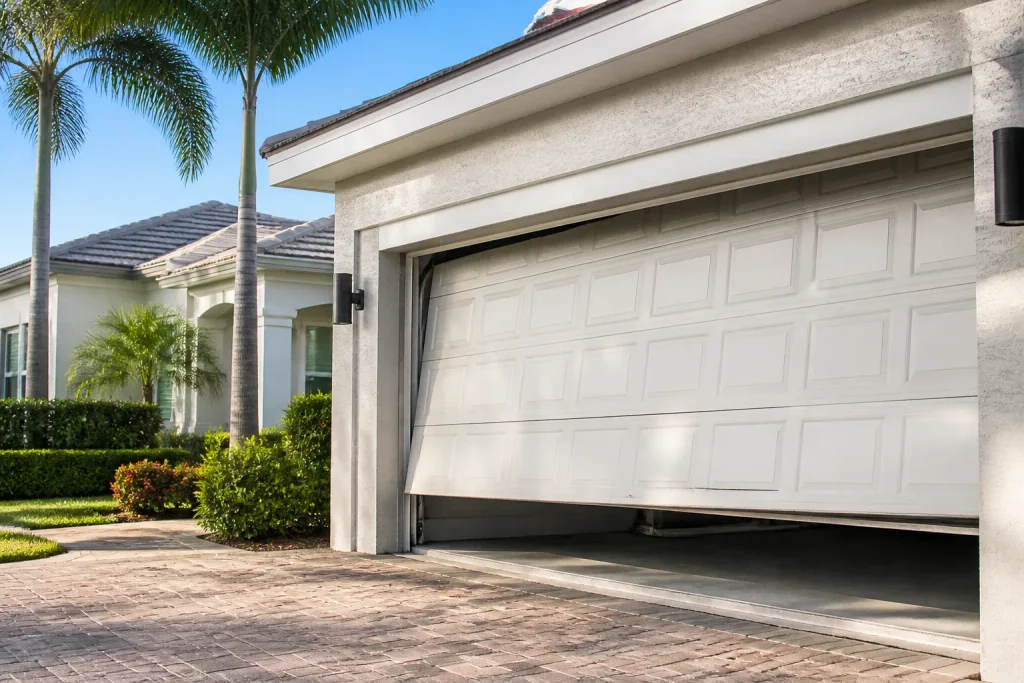
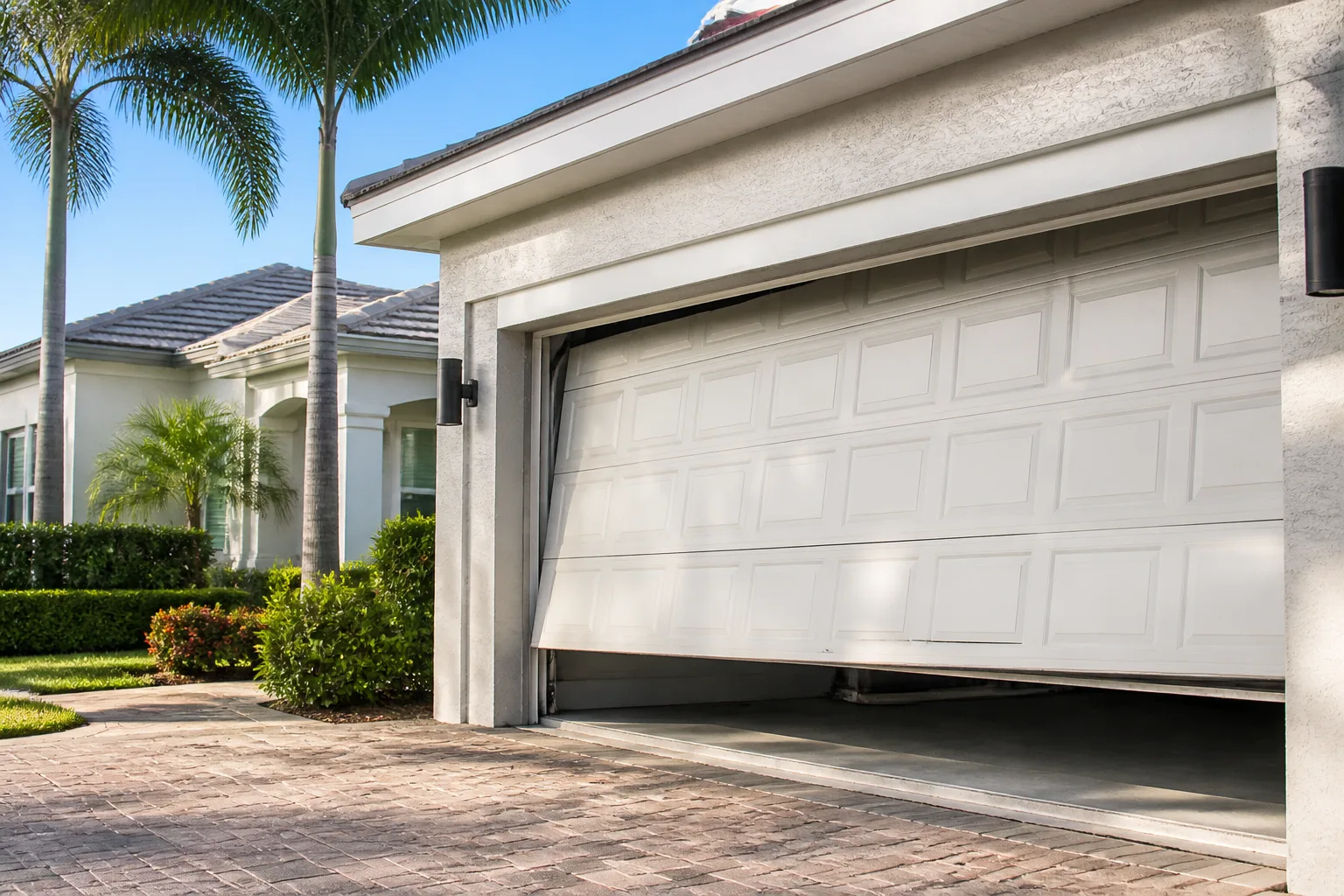
For a jammed, sagging, or off-track door, call a professional. Our garage door repair team handles every major system in a Pembroke Pines garage, and we’ve worked on the exact opener that’s failing on your wall. When a door is stuck open, we also run emergency service for a door that’s a genuine security problem at 9 pm – a garage left open overnight is a job that doesn’t wait for a convenient time.
What Brands Come Up Most on Pembroke Pines Doors
We work on eight major brands, and not all failure patterns look alike. LiftMaster and Chamberlain openers tend to hide travel-time drift well because their logic boards compensate for it – the door feels fine right up until it doesn’t, and that’s often a sign the motor is working harder than you’d notice. Craftsman and Genie units tend to show force-limit drift earlier because their safety reverse trips more readily. On the door itself, Clopay, Amarr, Wayne Dalton, and Raynor systems each have their own weak points and their own wear patterns. A technician arriving already familiar with the exact system in your garage skips the guessing stage.
The Bottom Line
Most garage door failures don’t happen suddenly. They finish a process that started months earlier with a slightly twisted cable, a worn roller, or a door that just got a little slower. The right order to check things is mechanical first, sound second – because noise means the wear is already advanced. If you’re noticing any of these signs on a Pembroke Pines door, catching it now usually costs a small fix. Catching it later usually costs more. We’re also happy to walk you through what a new system would involve when a repair stops being the right answer – see garage door installation for that conversation, and our Pembroke Pines Garage Door Repair Pros team keeps the full picture here.
If you’re in Pembroke Pines and need help, Pembroke Pines Garage Door Repair Pros offers free estimates – call (844) 793-5158. No dispatch fees, no surprise invoices. We quote the work and agree on the price before anything starts. Our technicians have up to 15 years of experience, and any licensed and insured local pro we connect you with is vetted to their state’s requirements.
Related services in Pembroke Pines: garage door repair, garage door opener repair, and garage door installation.
Frequently Asked Questions
How do I know if my garage door needs repair or full replacement? A single failed part – a spring, a roller, a safety sensor – is almost always a repair. Replacement becomes the better call when the door’s structural panels are warped, the tracks are bent beyond realignment, or you’re facing several separate failing systems at once. The right answer depends on seeing the door, which is why our estimate is free and the quote is written before any work begins. Call (844) 793-5158 for an exact quote.
Can a loud garage door really mean something is wrong? Yes. A door gets louder because something is rubbing, binding, or vibrating. That’s a mechanical problem, not an age issue. A worn roller or a hinge out of alignment can be a small fix if you catch it early. Letting the noise continue is what turns a small fix into a worn-out track or a fatigued spring.
What are the earliest signs of a failing garage door spring? The early signs are usually visual. Look at the torsion spring coil for rust, surface pitting, or a visible gap in the coil. Listen for a pinging sound when the door runs. A worn spring doesn’t announce itself before it snaps, and this is not a part anyone should try to replace on their own – the stored energy in the system makes it one of the most dangerous jobs in the trade. Call (844) 793-5158 if you suspect a spring problem.
Can you come out today if my door is stuck? For a stuck door that’s a security problem, we can usually schedule emergency service outside standard hours. Our technicians have up to 15 years of experience and work with every major system, so a stuck door isn’t a guessing game. Estimates are free, and we tell you the price before we touch a thing. Call (844) 793-5158.
Written by the team at Pembroke Pines Garage Door Repair Pros.
Need Garage Door Help?
Call Pembroke Pines Garage Door Repair Pros - the local pro we connect you with is licensed and insured, here with fast after-hours help in Pembroke Pines.
(844) 793-5158